 0
0
 0
0
By Sola Rotimi
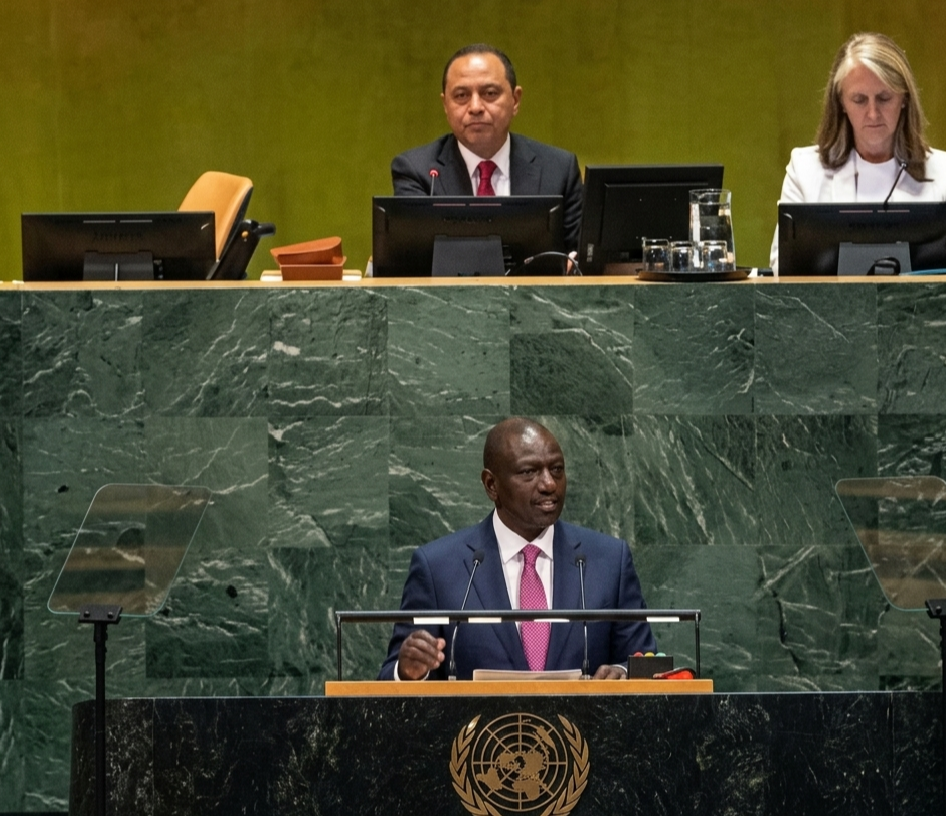
Kenyan President William Ruto has addressed the 81st Session of the United Nations General Assembly, delivering a forceful critique of the current international order and demanding a fundamental restructuring of both global security and financial institutions.
Speaking at the UN Headquarters in New York, Ruto declared that while the UN remains vital to global governance, the gap between the equality promised in the 1945 UN Charter and the power dynamics governing today’s institutions has become unsustainable.
A central theme of President Ruto’s submission was the structural imbalance within the UN Security Council as criticised the concentration of permanent veto power among five countries, contrasting it with the 188 member states that lack permanent representation.
He spoke tough on what he described as the complete exclusion of the African continent, which represents 54 sovereign member nations and over 1.5 billion people from permanent seats on the Security Council.
“Every nation in this hall has one vote. Every nation is sovereign and equal under the Charter. Yet on the gravest questions of war and peace, five nations possess a permanent power that the other 188 do not,” Ruto said, describing the exclusion of Africa as an indefensible historic injustice that undermines the global credibility of the United Nations.
Addressing ongoing global crises spanning from Eastern Europe to the Horn of Africa, the Middle East, and the Sahel, Ruto warned against selective adherence to international standards.
He stated that global trust is eroding rapidly because international norms and international law are frequently applied unevenly depending on geopolitics.
“International law cannot be invoked loudly in one crisis, cautiously in another, and disregarded when convenient. Every perceived double standard carries a price, and that price is trust,” he emphasised.
Turning to global development, the Kenyan President called for urgent reform of international financial institutions, stating that the current architecture imposes disproportionately high borrowing costs on developing economies.
Citing financial disparities, he noted that global public debt has reached record levels, with developing countries bearing an unsustainable interest burden despite accounting for a minority of total global borrowing.
He also pointed out that dozens of developing nations now spend more on debt service interest than on public healthcare or education.
“A road that is commercially viable should not become unviable merely because it crosses an African border,” Ruto asserted. “Capital must price risk; it must not price prejudice.”
He emphasised Africa’s vast demographic, agricultural, mineral, and renewable-energy potential, urging global leaders to view Africa through the lens of economic partnership and opportunity under the African Continental Free Trade Area (AfCFTA).
The Kenyan leader called on the global community to construct a truly multilateral system that reflects current geopolitical realities rather than post-World War II power dynamics.
“Let ours be the generation that completes the unfinished work of San Francisco,” Ruto urged, calling for a United Nations “where every nation has a voice, every people has a stake, and every child has a future.”


