

 0
0
 0
0
By Alfred Ajayi
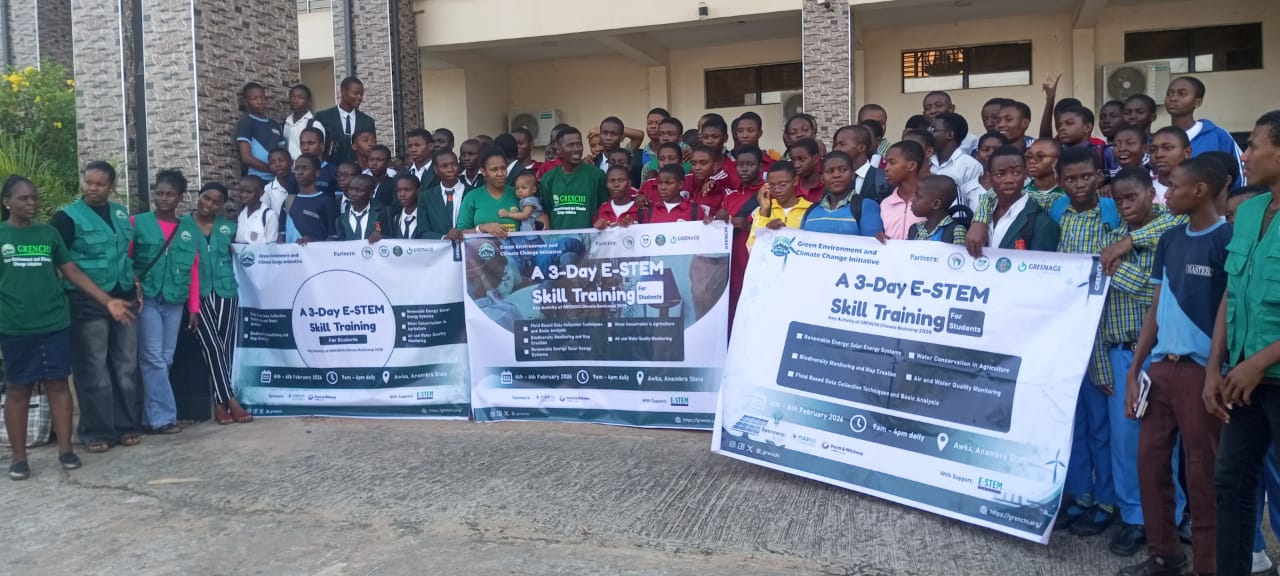
A Non-governmental Organisation, the Green Environment and Climate Change Initiative (GRENCHI), has equipped secondary school students in Anambra State with practical green innovation skills.
This is to build their capacity to join efforts to tackle climate change, water scarcity and environmental degradation.
The three-day E-STEM training in Awka empowered young participants with hands-on solutions in renewable energy, biodiversity conservation and sustainable agriculture.
The initiative was funded by the North American Association for Environmental Education (NAAEE) and Pratt & Whitney supported by other local partners including Greenage Technologies; the Departments of Crop Science and Horticulture, and Forestry and Wildlife at Nnamdi Azikiwe University (UNIZIK); the Sahelian Institute of Bamboo Research and Entrepreneurship Development (SIBRED); and the National Environmental Standards and Regulations Enforcement Agency (NESREA).
At the end of it, GRENCHI’s Programme Lead and facilitator for Water Conservation in Agriculture, Dr. Ropo Apalowo, expressed satisfaction with the depth and structure of the training modules.
“We exposed them to both theory and practical knowledge. The students now understand what a hydroponics system is and how to plant using soil-less media. They also know about vertical farming and different media they can use in crop cultivation.”
“We now have a group of young people who are not only educated in theory but also know how to implement these changes. When they return to their schools, they will act as peer educators. Young people learn from their peers, so the knowledge will spread within their schools and communities.”
Community Engagement Officer of GRENCHI, Grace Okoro, was impressed with the turnout and level of participation by the students and their teachers.
“We gathered seasoned resource persons. In each section, there were practical demonstrations, and the students and teachers were excited about the knowledge they gained.”
She urged participants to take the lessons beyond the training venue. “They should take the knowledge back to their schools, homes and communities.
Okoro disclosed that the students are expected to reconvene around June or July to pitch ideas developed from the training, expressing confidence that the outcomes would be impactful.
One of the students, Charles Ogbaga of Igwebuike Grammar School, Awka, said the training reshaped his understanding of agriculture. “What I’ve learned is that agriculture is beyond what we learn in school. It is practical. “Planting crops without soil is something we have never been taught.
Nonye Okpor Ginifor from Nwafor Orizu College Demonstration Secondary School, Awka, said he was leaving the training better informed. “I learned the art of hydroponics, where crops derive their nutrients from water instead of soil. I also learned that about 80 percent of water used in regular watering evaporates. But with drip irrigation, water goes directly to the roots, conserving it.”
For Emmanuella Okoye of Community Secondary School, Enugu-Agidi, the renewable energy segment was particularly impactful. “I learned about solar panels, solar energy and career paths like solar technician and energy auditor,” she said.
Obianuju Ejiofor, an SS2 student of Saint John of God Secondary School, Awka, described her exposure to biodiversity studies as enlightening. “From classroom sessions to zoo and forest visits, we learned to identify plants and animals and document their scientific names.
“This experience will not be in vain,” she pledged.


