

 1
1
 0
0
By Rasheedat Oladotun-Iliyas
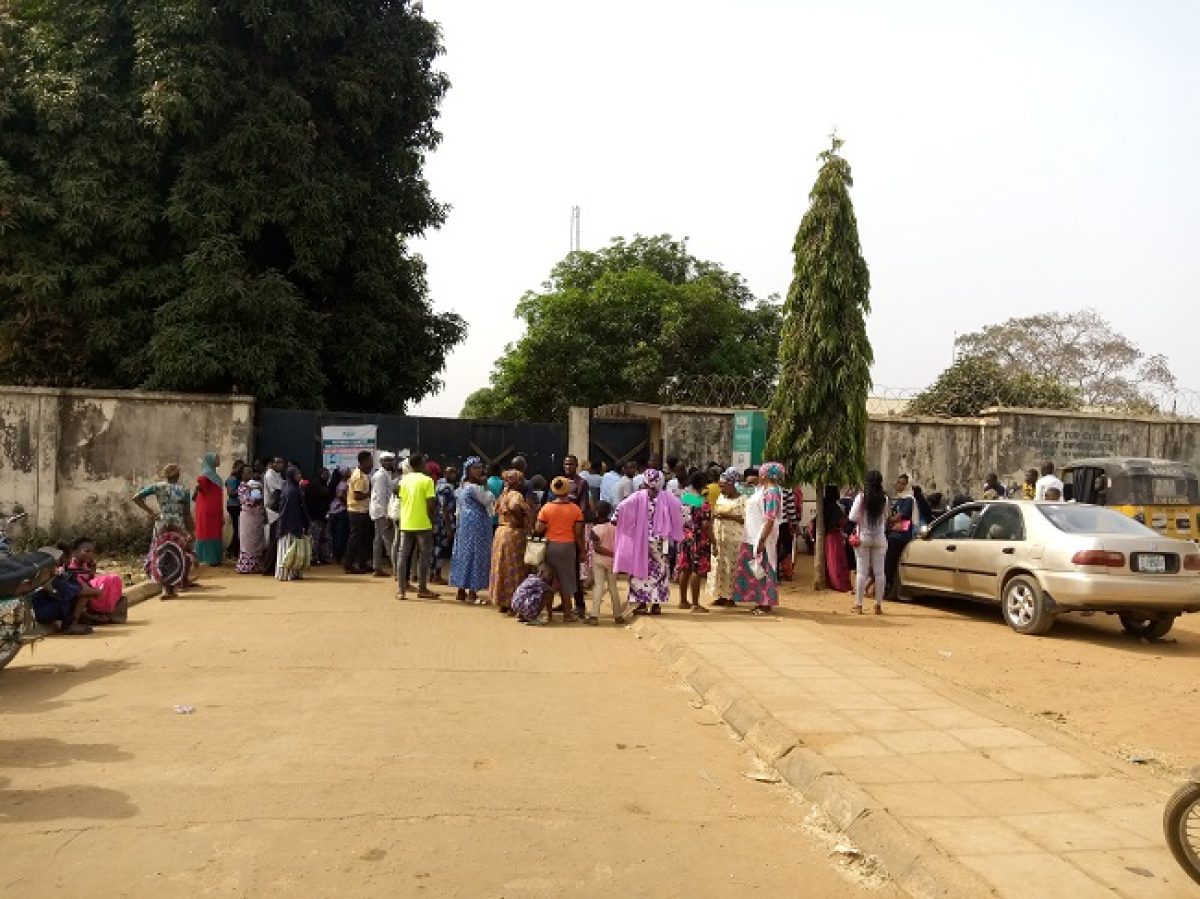
(NIMC office, Ilorin. Image credit: Google)
For two days Jameel has shuttled between his home and the National Identity Management Commission (NIMC State office along Asa Dam Road, Ilorin. He had come for modification of his NIN data to enable him to process his international passport. Yet, what should have been a routine Digital Public Infrastructure (DPI) service became an exhausting ordeal.
On his first visit, he met a crowd of applicants seeking new enrolment, data modification, or NIN reprints. Officials at the reception handed him a slip which serves as a tally.
“My number was 67. That was around 12pm o. And people were sitting around,.” he said. Unable to do what he came for, he left and returned the next day, Wednesday, much earlier.
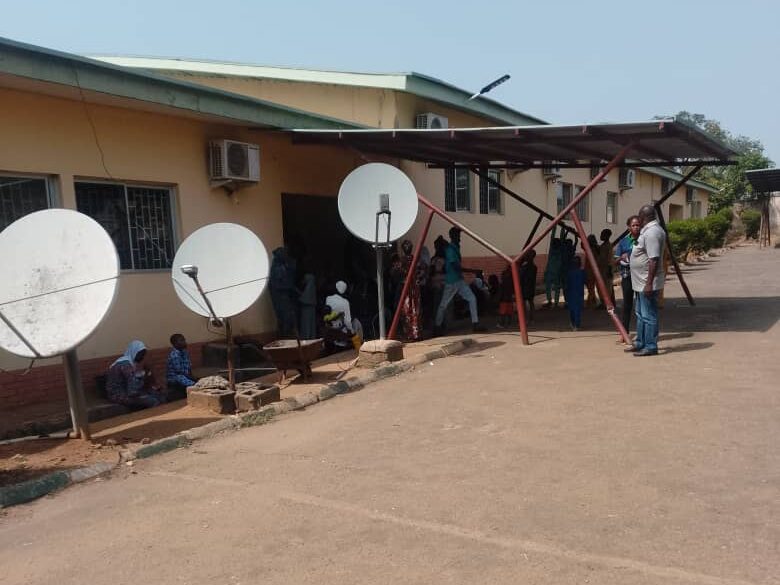
When the reporter visited the NIMC office that Wednesday morning, security personnel manned the entrance. Inside, applicants were scattered across the premises—some seated, others standing or leaving in frustration. As the reporter moved toward the registration building, she was greeted by the sight of people sitting on pavement by the walkway and under the trees.
At the entrance to the registration area, officials asked for her purpose of visit.
“Addition of name,” she replied.
“That’s modification,” the official responded, tearing out a number out of a line of numbers on a paper sheet and handed it over to the reporter.
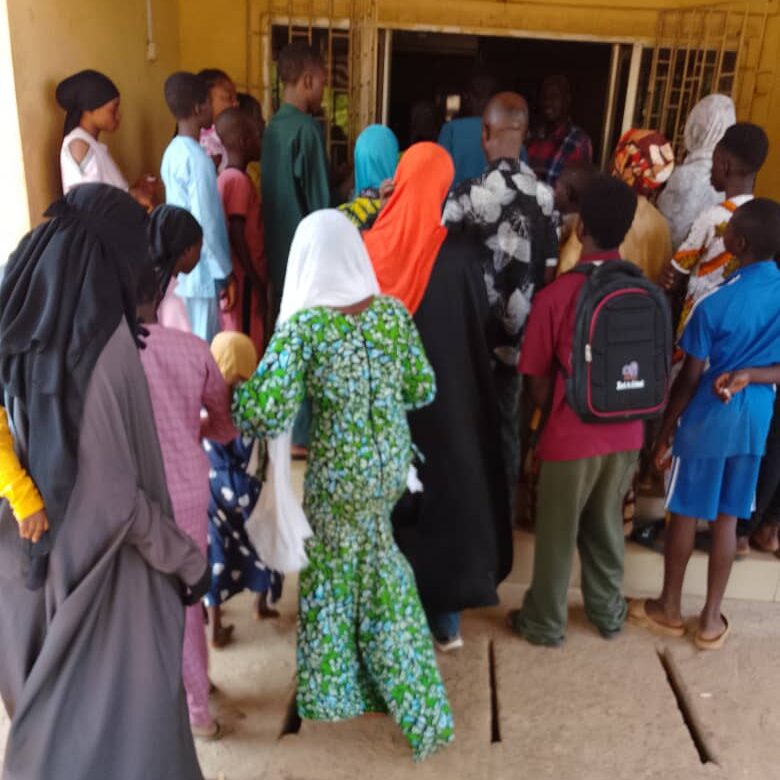
Inside the registration hall, applicants sat in sections: new enrollment, modification, and reprint. Officers assigned to data modification sat with NIN enrollment devices, intermittently glancing at the screens, engaging in side conversations, or responding to questions from applicants
“No network,” one of the officers, a woman, announced.
Some people stepped aside, others returned to their seats, some continued paying attention to their phones, while a few attended to their restless children and wards.
The network issue lasted for nearly an hour before it was restored and services resumed. People immediately rushed forward only to be halted by a tall black official with a loud voice who came in and barked instructions.
“What’s your number? Oya, go and sit down,” he said.
The enrollment process went on smoothly for about half an hour before another network disruption struck again causing unease, murmurs, hissing, and visible irritation across the hall. People quietly returned to their seats..
In the midst of these episodes, there was no consideration for the elderly, pregnant women, or nursing mothers. Everyone just wanted to be attended to, so as to access a service central to Nigeria’s digital governance system and leave the crowded hall.
According to Maryam, a regular visitor to the office, the experience is routine.
“ I was here last week, it was the same thing. It’s not the officials’ fault, it’s the machine. It’s either slow in loading or no network at all. It’s frustrating. Wasting all precious time here when I can be at home relaxing,” she said.
“Abi o,” a pregnant woman sitting close-by enough to hear her, chimed in.
NIN as Nigeria’s Foundational Digital Public Infrastructure
The NIN is the foundational digital identity of Nigeria, and it’s the cornerstone of the country’s DPI. It is required for every Nigerian to have it, as it is a pre-requisite to access several services including a mobile sim card registration or operating a bank account . It enables access to other essential services such as passport processing, social protection programmes, and government service delivery.
This centrality explains why many residents of Kwara State have continued to queue at the NIMC office to enroll or modify data. . However, a process which should take no more than ten minutes, becomes stretched into hours or even multiple visits due to network instability and downtime .
The entire enrolment and verification process relies heavily on digital infrastructure. Therefore, poor connectivity means data transfer is sluggish, leading to long queues, repeated visits and extended waiting time for applicants.
To increase their chances of being attended to, residents arrive as early as 5am. Even then. Early arrival offers no guarantee, as service delivery remains dependent on network availability and speed.
Network downtime and enrolment targets
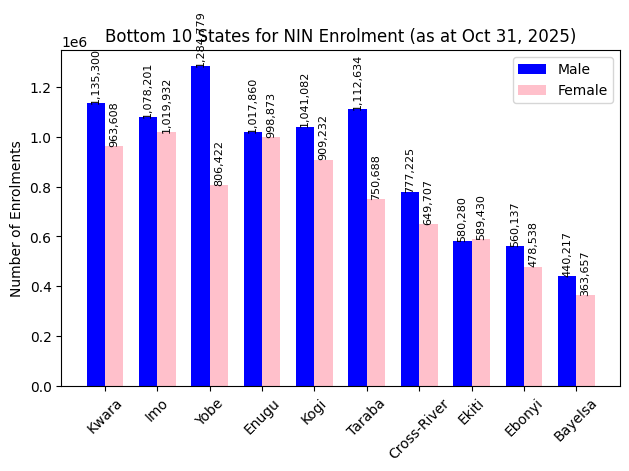
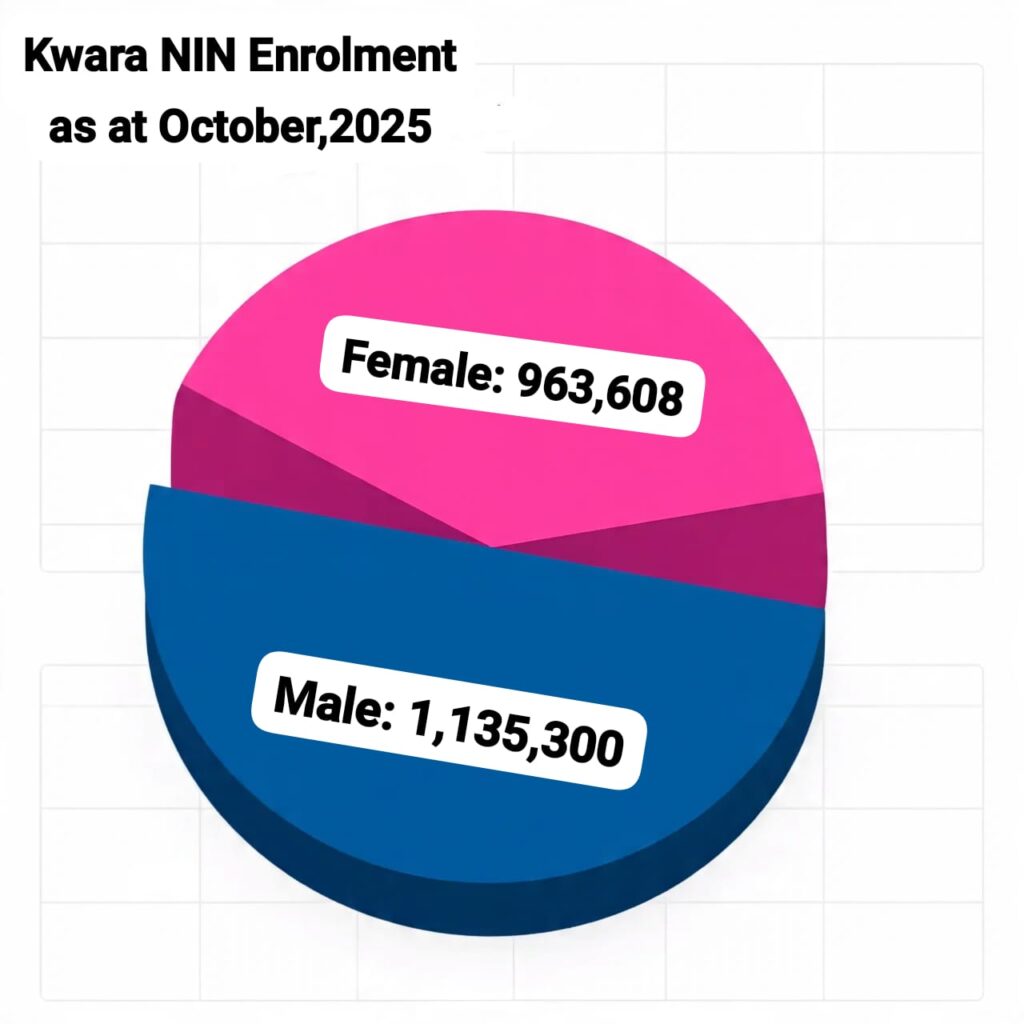
Data by the NIMC shows that as of October 2025, Kwara has a total NIN enrollment of 2,098,908 (Male:1,135,300; Female: 963,608) out of an estimated population of 3.3 million. This gap underscores the urgency of strengthening DPI delivery at the subnational level.
Aside from new enrollment, modifications of user data are mostly affected by network glitches. This is because enrollment officers needed to log into the NIMC portal to input new data or make corrections. And this requires a relaible network connectivity.
In 2022, NIMC Director-General, Bisola Coker-Odusote, attributed the disruption to service upgrades aimed at expanding the NIN database capacity from 100 million to 250 million, and the SIM-NIN linkage exercise. Available data also shows that the NIN enrollment devices and the associated NIMC verification portals experience downtime primarily due to high traffic, network instability, and infrastructure limitations.
These disruptions ripple across Nigeria’s DPI ecosystem. When the NIN system fails, banks cannot open new accounts, telecom companies cannot authenticate SIM registrations, passport processing stalls, and access to government services is delayed.
Irregular electricity supply further compounds the problem, as enrolment devices and backend systems depend entirely on stable power and digital interoperability.
Despite these challenges, the Commission has continued to argue that it is delivering on its mandate. At a workshop in Abuja, Head of Software and Biometrics, NIMC, Olushola Amurawaye explained that the Commission had improved on performances of its system and taken steps to make its infrastructure strong enough for services rendered.
“Some people will say NIMC service is down, that there is no network and so on. The Commission has invested in re-architecting some of our solutions making them tolerant and robust. Thus, you will hardly find a situation whereby they will say a NIMC service is down,” he said.
Amurawaye however clarified that NIMC does not work in isolation as it requires the efficiency of other service providers.
“NIMC does not provide electricity, we are not an internet service provider, our mandate is to maintain the national identity database and create it, which we are doing. Sometimes, people encounter issues, but it is not that the service is down. Some people may be complaining, and another person will say it is working. So, there could be some other reasons outside services provided by the Commission,” he stated.
A downtime too many
In 2022, enrollment and modification process were truncated as NIMC suffered an eight day downtime. This system glitch affected the operations of other agencies and organisations who depend on the NIN portal to provide key DPI services to people.
Galaxy Backbone Limited, “is a leading ICT services and solutions provider wholly owned by the Federal Government of Nigeria,” operating under the supervision of the Ministry of Communications and Digital Economy. The company established in 2006, “delivers digital infrastructure, network connectivity, cybersecurity, cloud, and hosting services to public and private sector organizations.” Galaxy Backbone provides ICT services for NIMC, during the 2022 network downtime, it claimed responsibility for the system glitch. The company also gave assurance that its “highly-skilled technical team of experienced Engineers and Applications experts” would “not just solve this current issue but put in place all the necessary structures to ensure that such an incident never occurs again in the future.”
Yet similar outages occurred in 2024 and 2025.
During the NIN-SIM linkage exercise in 2024, the President of the National Association of Telecoms Subscribers of Nigeria (NATCOMs), Adeolu Ogunbanjo called for a two-week extension to give more Nigerians time to participate because of a five-day NIMC server downtime.
In June, 2025, for three weeks, banks and Telecom companies complained about their inability to authenticate customer data through the NIMC portal, another reminder of the fragility of Nigeria’s DPI backbone.
The NIMCs Self-service Portal and NINAuth App
The NIMC has taken measures to ensure unfettered access to its services through system upgrades and improved infrastructure. To ease waiting time at enrolment centers, in December, 2025, the Commission launched the NINAuth self-service app. The Head of Corporate Communication at NIMC, Dr Kayode Adegoke, explained that the app allows new enrollment o their biodata online before visiting enrollment centres for biometric capture.
However, many residents especially in rural and low-income communities cannot use the NIMC portal nor the NINAuth app, due to low literacy level, lack of technology know-how as well as their mobile phone capacity, thereby getting excluded from these digital solutions.
Expanding Nigeria’s fibre optic penetration
Effective DPI services relies on strong internet connectivity and bandwidth penetration. However many rural communities in Nigeria still lack access due to the digital divide. In the Nigerian National Broadband Plan (2020-2025), the country projected a 70 % broadband penetration by 2025. However, official data by late 2025 showed that broadband penetration was approximately 50.58%.
Despite the 5G network which was launched in Nigeria by MTN and Airtel between 2022 and 2023 to provide high-speed connectivity across the country, the country has achieved only 11.8% penetration due to infrastructure gaps and high device costs.
In 2025, the World Bank approved $500 million financing package under Building Resilient Digital Infrastructure for Growth (BRIDGE) project, to support Nigeria’s efforts in expanding digital infrastructure. The project aims to “extend the national backbone from 35,000 to 125,000 kilometres which will bring reliable connectivity to all corners of the country and enable Nigeria to fully harness the opportunities of the digital economy,” it said.
Network expansion could curb service interruption, experts say
According to experts, the continued network downtime and system glitches must be addressed to reduce the number of visits applicants make to Enrolment Centers and the time spent there. In an interview, Ikechukwu Nnamani said continued and intense investment in fiber and 5G would improve NIMC services and help to achieve the full potential of a robust digital economy. This position was corroborated by a certified Engineer by the Council for the Registration of Engineering in Nigeria, (COREN), Ogochukwu Ikwuogu, who pointed out that studies have shown that Nigeria GDP growth could rise from 2–3% to 6–7% annually if she invests in effective fibre network expansion and digital adoption.
Also, a Tech expert, Osuagwu Ezeukwu said with a High Availability NIN Verification System, downtime challenges experienced by the National Identity Management Commission, NIMC, banks, and other service providers would be addressed.
“When you have a central system like this that different industries rely on to run their local and specific processes. It is important to make it handle load, to be able to handle traffic,” he said
This report is produced under the DPI Africa Journalism Fellowship Programme of the Media Foundation for West Africa and Co-Develop.


