 1
1
 0
0

(Al generated image)
Nigeria’s student loan scheme managed by the Nigeria Education Loan Fund, (NELFUND) shows how Digital Public Infrastructure (DPI) is reshaping access to education financing. Using the National Identification Number (NIN), and Bank Verification Number (BVN)), interoperable databases and digital payments systems, the scheme which is under the Students Loans (Access to Higher Education) Act, verifies applicants, process loans and track repayments. Unlike previous loan programmes that failed because of weak identity verification and poor repayment systems, NELFUND links government agencies, financial institutions and tertiary institutions through integrated digital platforms, improving transparency, accountability and loan administration. Rasheedat Oladotun-Iliyas reports.
“””””’””””””””””””””””””””””””””””””””””””””””””””””””””””””””
“I had given up on my education. I thought I would not be able to complete it. My father died and my mother is a petty trader. Then, this NELFUND came,” said Tade Isaac, a 300-level Accounting student in Kwara State.
Isaac dreams to be a Chartered Accountant in a multinational company someday but that dream could have been aborted or delayed due to financial constraints. However, his hope was reignited with the launch of NELFUND. “With NELFUND paying my school fees, I can concentrate on making good grades to secure the future I dream of,” he said.
The Nigerian Education Loan Fund, (NELFUND) is a government agency powering the Student Loan Initiative in Nigeria. The fund, officially launched in May 2024, was established following the Student Loans (Access to Higher Education) Act, which was signed into law by President Bola Tinubu in April 2024.
The loan settles tuition fees and upkeep allowance, and is accessible to Nigerian students based in the country who gained admission into Federal or State owned universities, colleges and polytechnics.
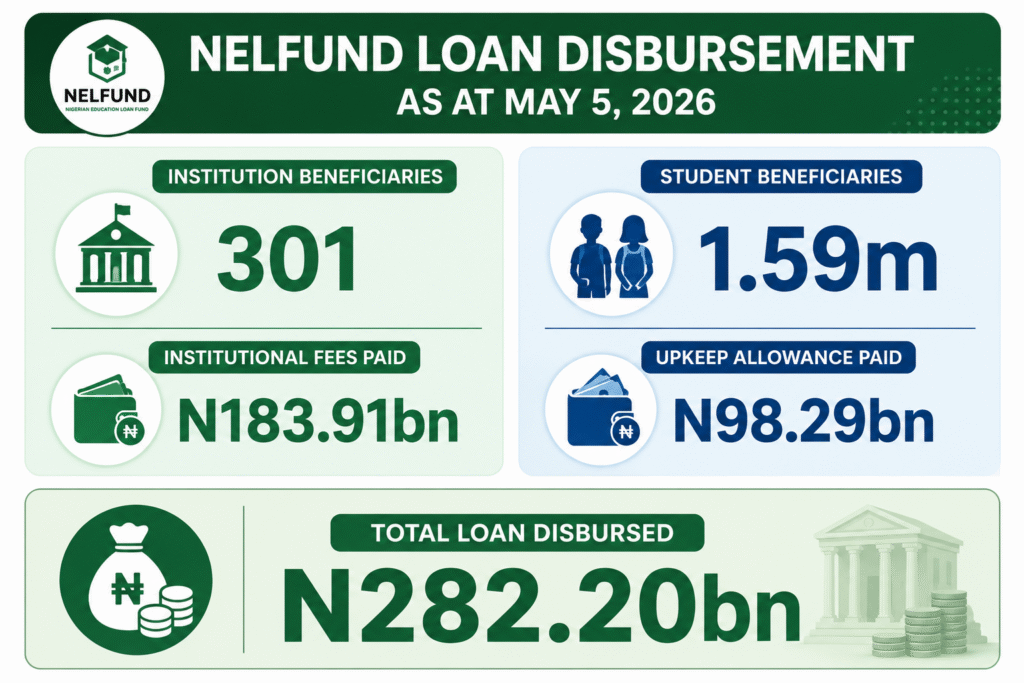
The NELFUND’s database states that as of May 5th, 2026, a total of ₦282.20 billion has been disbursed. Of this amount, ₦183.91 billion was paid as institutional fees, while ₦98.29 billion was disbursed as upkeep allowances. Overall, 1,586,921 students have benefited from the scheme, with the number of beneficiary institutions put at 301.
In Kwara State, 53,625 students registered for the scheme. A total of 132,276 loan applications were submitted, comprising 68,086 applications for institutional loans and 64,190 applications for upkeep loans.
At an end of the year media briefing in December, 2025, the Minister of Information and National Orientation, Mohammed Idris, describing NELFUND, said, “No young man or woman of school going age should be left out of school simply on the account of the inability of parents or guardians to pay for tuition and also to pay for upkeep. You don’t need to know anybody to connect with NELFUND.”
How NELFUND works
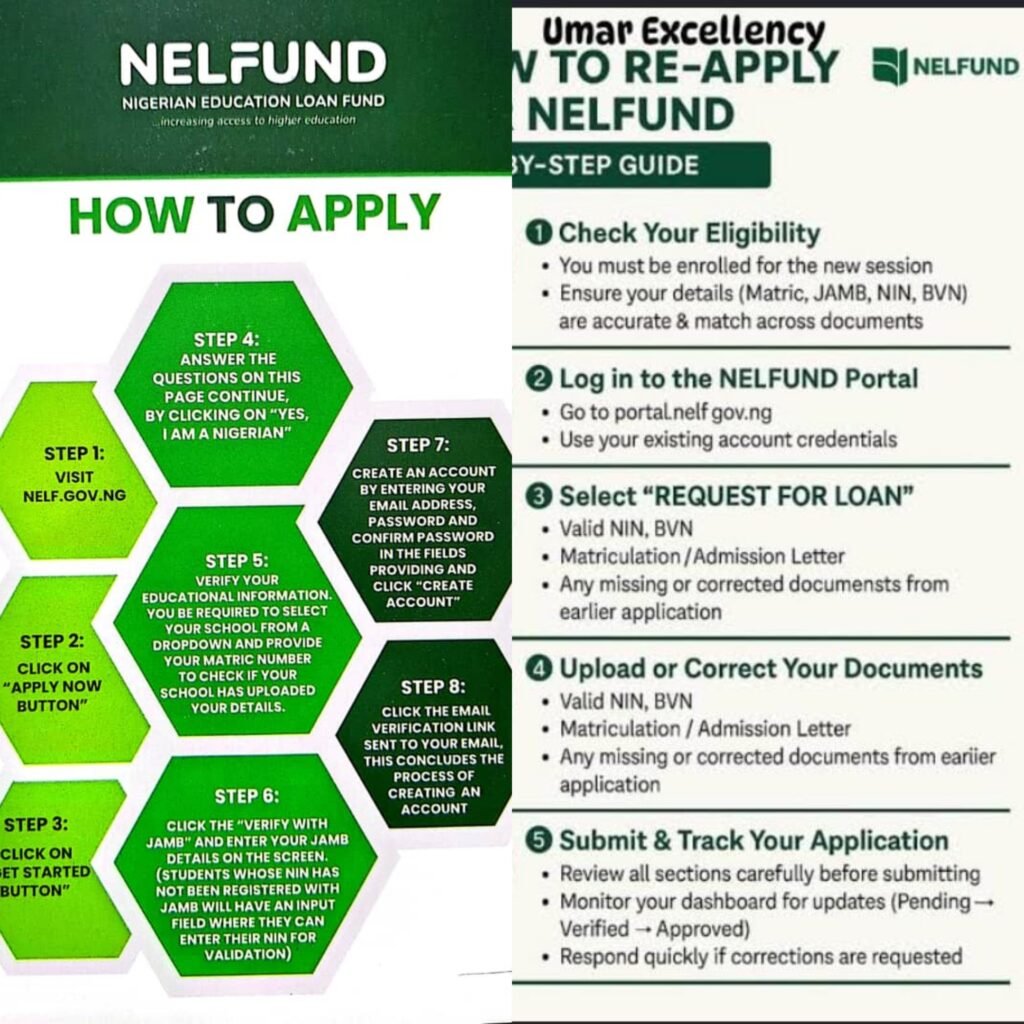
NELfund has a dedicated application portal for student loans. The portal requires that interested students create an account and verify their identity using the National Identification Number, (NIN) and Bank Verification Number, (BVN).
The student must be a Nigerian schooling in the country to access the form and then they are required to fill in the name of their institution and matriculation number before proceeding. The matriculation number is a unique number given to every registered student of a particular institution. Failure of the portal to verify the student’s matriculation number and name of institution makes the complete form inaccessible.
These details are mandatory for identity verification, proof of citizenship, and processing the loan disbursement. For a successful application, the names and details connected to the student’s NIN, BVN, and JAMB/school profiles must all match exactly.
The loan which is interest free and payable two years after the mandatory National Youth Service Corps (NYSC), covers monthly payment of N20,000 upkeep allowance and full payment of institutional fees. While the tuition fees are paid directly to the school, upkeep allowance is paid directly into the applicant’s account number. The fund is opened to both new and returning students
The DPI-enabled student loan initiative
The digital tools enabling government’s disbursements of the student loans are the BVN backed by the foundational digital identity, NIN. These verifiers matched with the student’s matriculation number are required before an application is approved and disbursement made.
Prior to the establishment of NELFUND in 2024 there have been several programmes by the Federal Government to assist students pursue academic life without being hindered by financial constraints. In 1972, the military government of Yakubu Gowon established the Nigerian Students Loans Board (NSLB) through Decree 25). The fund assisted students at home and abroad to cater for financial issues. However, it failed due to poor repayment tracking.
According to reports, only a 13% of the disbursed loans were recouped. Another attempt was made in 1993 to address the structural failures, when the government introduced the National Education Bank, popular referred to as EDUBANK. However, Edubank never fully became operational.
But the NELFUND has been operational for two years and has witnessed successful disbursement. What changed? NELFUND Managing Director, Akintunde Sawyerr said the upgrade in technology and the use of digital identity platforms has made verification of eligible students easier and faster. He also expressed confidence that using the same platform, backed by the Global Standing Instruction, GIS, Recovery, loan retrieval would be seamless.
GIS is a loan repayment enforcement mechanism introduced by the Central Bank of Nigeria (CBN) to help financial institutions recover unpaid loans and reduce bad debt in the banking system.
“If you have money there (bank account) and you are telling us you are not working. We can see your account and we can take the money,” he said
This system had proven effective in the retrieval of the Federal Government COVID-19 loan under NIRSAL. Through NIN, beneficiaries of the loan were tracked while BVN aided in the recovery of the loan. A beneficiary, Motunrayo Muideen who tried to evade repayment, explained that she was tracked to other bank accounts linked to her BVN.
“They have been deducting money from my bank account since then. The money they are withdrawing is not much. I collected N400,000 and used it to buy a deep freezer. It has been very useful for my business,” she said
Unlike previous student loan initiatives NELFUND leverages interoperable data platforms for loan processing, disbursement and tracking, which has proven the inherent benefits of DPI across all sectors of the economy.
NIN, which is the foundational identifier, was introduced in 2007 and made compulsory by Sections 27 and 29 of the National Identity Management Commission Act (2007), for accessing several government services. This is similar to the use of Social Security Number and National Insurance Number for accessing services in the United States of America and the United Kingdom respectively. In 2020, it became mandatory to link one’s mobile number with the NIN. This was after the BVN which was introduced in 2014 and requires linkage to one’s NIN and mobile number. Each of this platform collects biodata, fingerprints and facial images of enrollees. This interconnectivity across digital identifiers and digital student records by participating higher institutions made NELFUND tasks easy and beneficiaries trackable even after schools. With strong policies guiding these identifiers, they have become reliable.
With strong policies ensuring that NIN is not irreplaceable and BVN is not transferable; policies that mandate linking every bank account operated by owners to their BVN and ensuring that mobile numbers linked to BVN are almost irreplaceable; It becomes digitally impossible for any beneficiary of the Student Loan Initiative to abscond repayment after the given timeframe of two years after mandatory NYSC.
Repayment is put at ten percent of monthly salary while an amount will be decided in the case of self employment.
Students loans are operational in over 75 countries of the world with each of them having different or mutual policies and eligibility criteria. However, the motive behind the loan is the same – to relieve students of academic financial stress. In the United Kingdom, the government operates the Student Loans Company (SLC), which issues loans for tuition and maintenance. The scheme features income-contingent repayments, meaning students only pay back when they are earning above a certain threshold.
Nigeria is not the only country operating student loans in Africa. Several other African countries operate established student loan schemes to support tertiary education. Prominent examples include Kenya where the Higher Education Loans Board (HELB), considered to be one of the oldest and most structured revolving funds in Africa, provides loans and scholarships for students in universities and TVET institutions.
Wins and pitfalls
Critics argue that excluding students in private tertiary institutions NELFUND is discriminatory, while some others contend that those who choose private institutions generally have the financial capacity to fund their studies. There have also been calls to expand the scheme to cover off-campus accommodation and convert the loans into grants
Despite widespread praise from students and parents since its launch, the scheme recently faced criticism over delays in the payment of the N20,000 monthly upkeep allowance. Some beneficiaries, who said they usually receive payments by the 26th of each month, reported that as of June 22, 2026, the May allowance had not been paid. Comments on NELFUND’s X account reflected the frustrations of affected students, many of whom received no direct response.
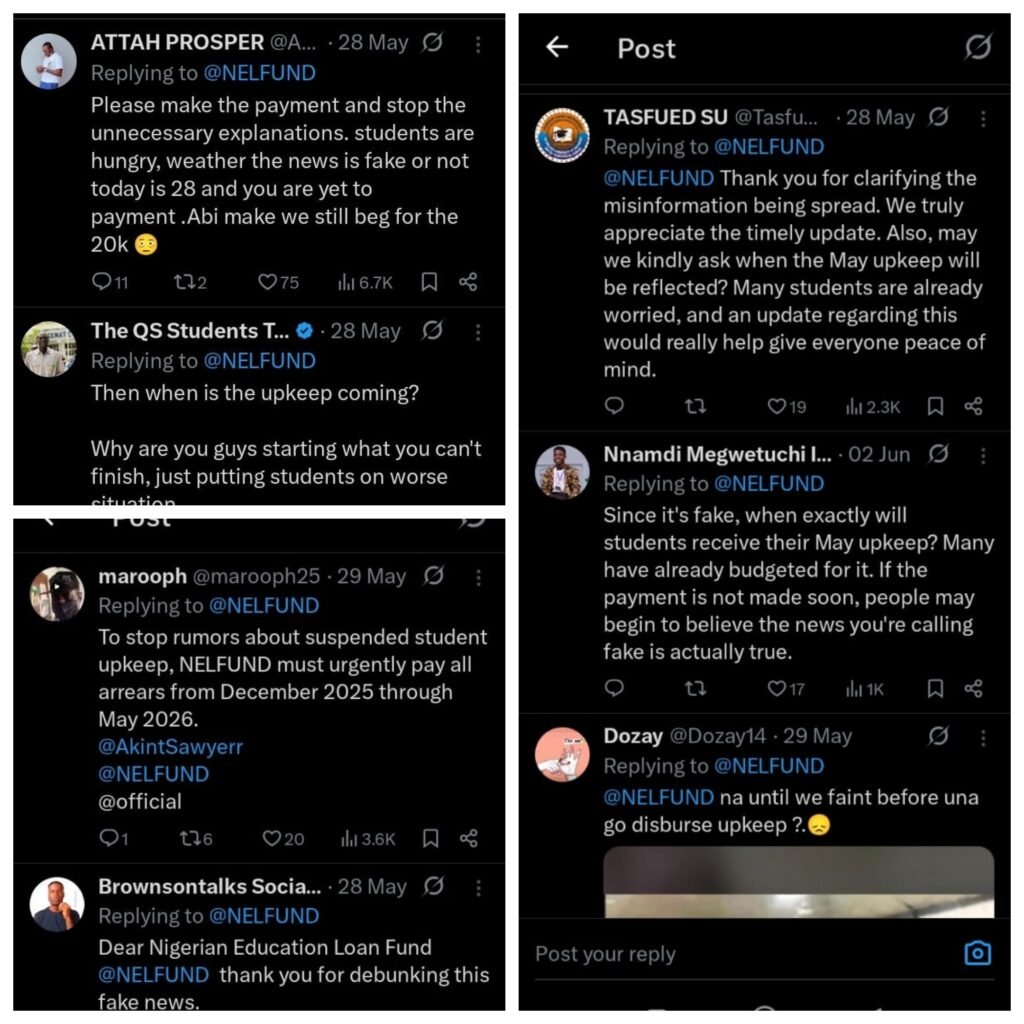
Earlier, on May 28, 2026, NELFUND dismissed as false reports that the Federal Government had scrapped the scheme. It also attributed delays in payment alerts to processing timelines, including institutional verification, bank details and application batches.
The Managing Director of NELFUND, Akintunde Sawyerr while addressing concerns about transparency explained that loan applications undergo multiple verification stages involving both the agency and beneficiary institutions before payments are approved.
“Students apply to us for these loans. We collate the students, we verify them, or we check to ensure that they are indeed eligible. We then send that finalised list to the school. The school checks that the students are there — remember they applied online, there’s no interface between us and them.”
He continued. “The school checks, looking at the records, whether the students that we’ve sent to them have applied and are indeed their students, they’re still alive, they’re still active, and they are still bona fide students.
“The school then has to send back to us, electronically, the list that they confirm. One of the things that they also have to do is ensure that the fees are correct. Okay. Now, in doing that, some schools omit some students, some students are removed from the process, but we ensure that we pay what is approved,” he added.
Akintunde further said that some students may have to pay for their tuition before disbursements are made by the agency due to the verification process but he affirmed that the institutions are required to refund the affected students after disbursements are made.

He added that integrating the NIN, BVN and institutional records has reduced fraud, eliminated duplicate records and simplified access to the scheme. Parents say the programme has eased the financial burden of higher education.
A parent in Ilorin, Kamal Alao said he no longer feels uneasy when his children in higher institutions are returning to school.
“I don’t worry again. I just focus on what they eat and what school materials they need to help their studies. The programme has really helped a lot.”
Another parent, Ganiyah Babatunde, said the initiative is helping families concentrate on other needs. “They said we will pay later, no problem, God will provide. At least the money will be removed gradually. We are optimistic. We only pray for a good outcome after school. Employment or self employment that will be good enough.”
School administrators noted that the DPI backed initiative has increased student enrolments and the institutions no longer worry about school fees payment.
According to the NELFUND Desk Officer at the Federal Government College of Agriculture, Akure, Ayodeji Arisoyin, a large percentage of NELFUND beneficiaries in the institution would have withdrawn from school if not for the fund.
“Over 50% of these students are in school because of support from NELFUND otherwise some would have given up. All we asked them to do once you are given admission, go and apply for NELFUND. Once you applied, once you applied, then you have become our bonafide student, even when the fund , even when the fund has not been disbursed to the school. Interestingly, the funds have been disbursed as and when due,” he said.
Similarly, Dr Kayode Sule, Dean of Student Affairs who recounted how he used to sign undertakings on behalf of students during examinations due to school fees debts, said that has become history. He affirmed that the fund had indeed increased students enrolments and checked withdrawal from school due to financial constraints.
One of the beneficiaries of NELFUND is a two hundred level student at the Kwara State Polytechnic, Bayo Badmus.
“The initial fears have been surmounted. I didn’t want to apply when it started because people were saying it was a trap. Now, we all know better. We just want the government not to allow it to die. It should be institutionalised such that change in government and political parties will not affect it. A lot of students now have hope when it comes to finances. What we want now is stability, continuity, security and an improved economy.”
——————————————-
This report is produced under the DPI Africa Journalism Fellowship Programme of the Media Foundation for West Africa and Co-Develop.


